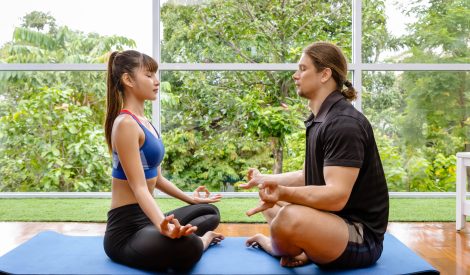
Yoga is a philosophical and practical discipline from ancient India. It dates back several thousand years and has undergone many transformations throughout its history. Yoga, as it is taught and practiced worldwide today, is a system for developing the whole personality in harmony with the natural and social environment of the human being. Special emphasis is placed on a system of physical exercises (asanas), breathing exercises (prānāyāma), deep relaxation (yoga nidra) and meditation that has been tried and tested for many centuries.
Yoga for Wellness
This system is individually adapted to the living conditions of our society and the state of health of each person. Yoga also plays an important role in the healing process of physical and mental disorders. In the ancient source texts we find the parable of the chariot with a team of horses and the charioteer. In a figurative sense, yoga means reining in the wild horses of the five senses in order to guide the chariot of our personality easily, quickly and safely to its destination: to the realization of ourselves and the world in which we live; to the unfolding of our dormant potential, to the experience of oneness with the universe and with the divine primal principle of creation.
Yoga as a philosophy
In ancient India, yoga was not a “wellness” movement, but rather an intensive physical, mental and spiritual training. We can preserve essential aspects of this ancient discipline, but we must adapt it to our modern times. Yoga in its broadest sense is still today a demanding path and a precise science of the human being – not only a physical discipline with outstanding health benefits, but also a very subtle philosophy that unfolds through holistic work on the body, mind and psyche. Yoga, as it is understood in our tradition, is life-affirming and open. It is based on an approach that includes the body as an instrument of knowledge.
Holistic understanding of yoga
Yoga is the science of life and the teaching of the elimination of contradictions and disturbances of consciousness. A wide variety of yoga techniques were described thousands of years ago in India. They all aim to develop awareness until it is so all-encompassing that a person can experience themselves as a holistic being, connected with body, mind and soul. However, when we talk about developing awareness, this is not a process that can be limited to a specific time each day. Above all, awareness means self-observation and discipline in everything we do or think. Once the need for this has been recognized, this process begins, slowly and in a fragmentary way at first, but gradually it gains such intensity that the whole of life becomes the subject of this observation – and this is where yoga begins. The system of yoga describes in detail the theory and practice of developing awareness. In order to reach the goal, the unity of man with the whole universe, all obstacles on this path must be removed, i.e. all five sheaths of Koshas, our spiritual core, are purified and harmonized. Above all, it is important to provide all levels of being with the right “food” in equal measure.
Ayurveda and yoga – they work better together
This is where the duality of Ayurveda and yoga comes into play. Ayurveda focuses on balance on the physical level, while yoga focuses on balance on the mental and emotional level. Ayurveda teaches us to find the right balance, to experience harmony with the rhythms of nature, to strengthen physical strength and life energy and to live vitality in everyday life.
Mental development and physical balance are the two poles – both belong together.